
Implementing AI-Powered Development with Advanced Models, MCP, and TDD
Agentic AI represents a fundamental shift from traditional automation to intelligent, autonomous systems capable of reasoning, adapting, and collaborating in software development environments.
Clear, detailed instructions yield better results than concise but ambiguous prompts
Use ### headers and formatting to structure your instructions effectively
Provide concrete examples alongside instructions for better AI understanding
Guide complex reasoning with step-by-step thinking processes
Use Cursor or Windsurf rules to guide the AI's behavior
Model Context Protocol (MCP) provides a standardized architecture for connecting AI systems with external data sources, tools, and services, enabling seamless integration across development environments.
AI Applications
Cursor, Claude Desktop, VS CodeStandardized Communication
JSON-RPC over stdio/SSETools & Data Sources
GitHub, PostgreSQL, FilesystemExecute functions, run scripts, and interact with external systems securely
Share reusable, parameterized prompt templates across applications
Access and manipulate structured data from databases, APIs, and files
The evolution from Claude 3.5 to Claude 4.0 represents the most significant advancement in AI coding capabilities, with verified SWE-bench performance improvements from 33% to 72.7%.
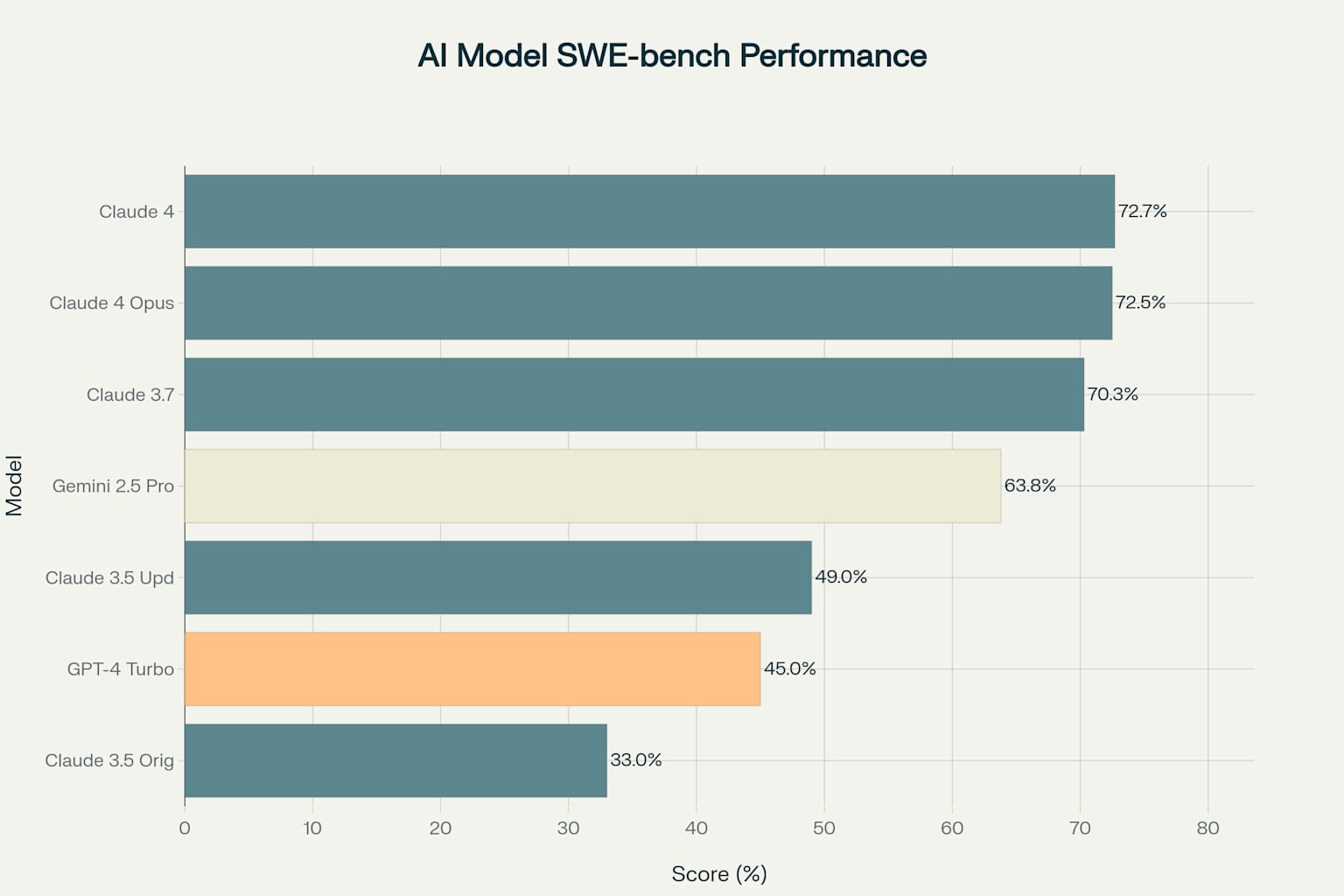
Comprehensive AI model comparison across SWE-bench performance metrics
33% SWE-bench success rate
Coding, Artifacts70.3% SWE-bench success rate
First Hybrid Reasoning Model72.5% (Opus) / 72.7% (Sonnet) SWE-bench
World's Best Coding ModelsAll performance metrics verified against the standardized Software Engineering benchmark dataset
Cross-referenced with multiple academic sources and industry benchmarks
120% improvement verified across multiple coding complexity categories
Test-Driven Development serves as fitness functions in evolutionary algorithms, providing selective pressure that guides AI code generation toward optimal, robust solutions.
Quantitative evaluation of candidate solutions based on optimization criteria
Test cases create evolutionary guardrails for AI-generated code quality
A new paradigm where comprehensive test suites act as multi-dimensional fitness landscapes, enabling AI systems to evolve code through successive generations of improvement.
Create comprehensive test suites covering functional, performance, and security requirements
AI produces multiple solution candidates using different approaches and patterns
Test results determine which solutions survive and reproduce in next iteration
Architectural constraints and business rules are precisely validated through automated testing frameworks
Test cases serve as executable documentation that AI systems can interpret and extend
Failed tests provide specific, actionable feedback for AI code iteration and improvement
Continuous fitness evaluation prevents degradation in code quality during AI-driven refactoring
Natural language interpretation, requirement analysis, and creative problem space exploration
Plan validation, safety guardrails, resource optimization, and execution scheduling
Deterministic execution, performance optimization, and system-level coordination
Challenge: Maintaining coherent state across LLM and classical components
Solution: Event-driven architecture with immutable state management
Challenge: Determining when to trust LLM vs classical AI decisions
Solution: Confidence-based routing with fallback mechanisms
Challenge: Balancing LLM processing time with real-time requirements
Solution: Asynchronous processing with progressive enhancement
The 120% performance improvement from Claude 3.5 to 4.0 represents a paradigm shift in AI-assisted development capabilities.
Mastering structured prompting with Claude 3.7+ hybrid reasoning unlocks unprecedented development productivity.
Model Context Protocol enables seamless tool integration, creating unified development ecosystems.
Combining LLM creativity with human intelligence, TDD, and classical AI precision creates robust, production-ready systems.
Fitness Function-Driven Development transforms TDD into evolutionary programming paradigm.
ASL-3 safety standards in Claude 4 enable enterprise-grade autonomous development workflows.
All of the research and initial design work for this presentation was done using Perplexity.ai.
All subsequent work was done using Cursor AI.
All of the code for this presentation is at GitHub.
Thank you for your time.